

Breaking the Silence: Australia’s New Approach to Antidepressant Tapering
For decades, patients prescribed antidepressants have faced a troubling reality: while starting medication is often straightforward, coming off it can be anything but. Withdrawal symptoms are frequently misdiagnosed as relapse, and tapering plans — if offered at all — are vague, rushed, or nonexistent.
But in Australia, a quiet revolution is underway.
The Problem: Prescribed Without an Exit Strategy
Antidepressants are among the most commonly prescribed medications in Australia. Yet many patients report being started on these drugs without a clear plan for discontinuation. When they try to stop, they encounter symptoms like insomnia, anxiety, brain zaps, and emotional instability — only to be told they’re “relapsing” or “treatment-resistant.”
This cycle not only undermines informed consent, but it also traps patients in long-term medication use they never agreed to.
The Response: RELEASE Toolkit and Hyperbolic Tapering
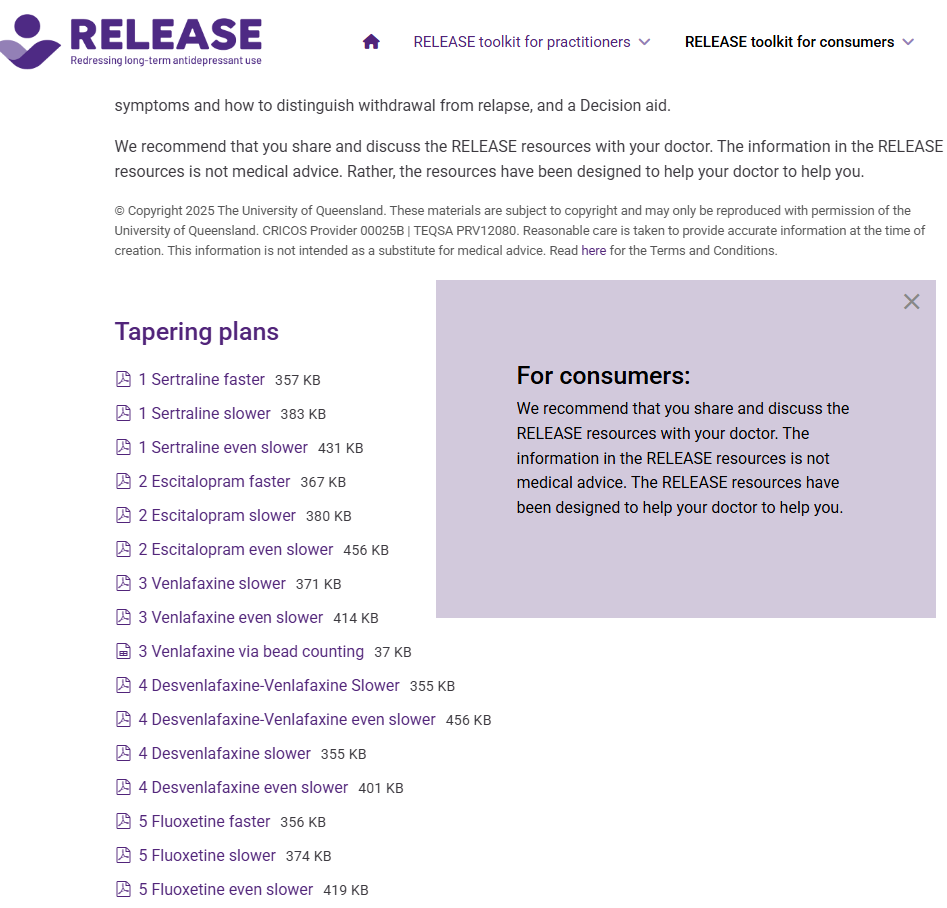
Developed by researchers at the University of Queensland, the RELEASE Toolkit offers a groundbreaking solution. It provides:
- Hyperbolic tapering schedules for 15 common antidepressants
- Slow, even slower, and faster tapering options tailored to individual needs
- Patient-centered resources, including decision aids and printable plans
- Co-designed with lived experience, ensuring real-world relevance
Unlike linear dose reductions, hyperbolic tapering reflects how the brain responds to medication changes — with smaller reductions at lower doses to minimize withdrawal.
Why This Matters
This shift isn’t just clinical — it’s ethical. It acknowledges:
- Withdrawal is real, not a sign of relapse
- Patients deserve informed consent, including risks and exit strategies
- Prescribing must include deprescribing, with support and transparency
The Royal Australian College of General Practitioners (RACGP) and the Pharmaceutical Society of Australia (PSA) have endorsed these resources, signaling a broader cultural shift in psychiatric care.
Advocacy Implications
For advocates, the RELEASE Toolkit is more than a clinical guide — it’s a tool for empowerment. It validates survivor experiences, challenges medical spellbinding, and offers a practical path toward harm reduction. It’s time other countries followed suit.
One would agree that humans WORLD WIDE can use these tapering charts as a guide to come off the most common antidepressants that most doctors do not know how to DEPRESCRIBE!
Mystery solved, thank you Dr. Horowitz for your continued efforts to help millions and thank you Australia for making this publicly available for anyone!!!

